How to Make More Money From the Same Website Traffic
Most businesses focus on getting more traffic when they should be fixing their conversion funnel. Learn the seven invisible leaks costing you customers and the simple interventions that can double your revenue from the same visitors.
You are getting traffic. A lot. You've invested heavily in ads, content, partnerships—bringing qualified people to your site every day. But if you're truthful, most of those people don't make a purchase.
They come, check the place, and go. Next month, you spend the same amount to bring in the same people who will do the same thing: not buy.
This is the main reason of failure for online businesses which you don't hear about. It's not your product. It's not the quality of your traffic. The issue is that your conversion system has some invisible leaks and you are losing money without knowing where it's coming from.
The harsh part? You don't have to fix your traffic problem. You already did that. What you really need to do is fix your conversion problem. And that's where the real money is.
The Seven Conversion Killers Destroying Your Revenue
Let's figure this out properly because every founder I talk to has the same story.
You have 10,000 visitors a month. Your conversion rate is 2-3%. "That's pretty normal," everybody tells you. No, it isn't. It's allowing 97 out of every 100 potential customers to go unconverted. It's not a metric—it's a catastrophe waiting to be resolved.
However, it's never clear why they leave. They don't send you an email with their complaints. They don't find a broken feature and quit. They simply... vanish. And you have to guess.
Here is the reality:
Your international visitors think you are twice as expensive as you really are. A developer in Brazil seeing $49/month thinks "that's half my salary." So, she terminates the tab. Your US competitors never getting the hint, think that you are not available in emerging markets and thus, they are safe. In the meantime, whole areas of talented people who would be delighted with your product have become permanently inaccessible.
Your visitors are being pulled in different directions. They are on your site, they read, they get interested. However, they open a new tab to just quickly compare you with a competitor. In 30 seconds, they are gone forever. You never get another opportunity because their attention never returns.
You resemble every other corporate software company. Your landing page is neatened and done professionally. No founder video. No human face. Simply stock images and copy that could be from any company. Visitors have no reason to trust you uniquely so they decide to go with the one who is willing to show their face.
You do not have any data on what really works. You think that your headline converts better than the other one but you are only guessing. You change your CTA button color because you have a feeling. Nothing gets tested because testing seems like you would need an engineering team and three weeks of planning.
Your visitors are one objection away from buying, but they leave before you can address it. They are at the bottom of your page, truly interested, but something is still holding them back. A question about pricing. A missing feature. A trust issue. You never discover it because they go to another page.
No one sees that other people are actually buying. Your social proof is a few paragraphs down in a testimonials section that nobody reads. Meanwhile, visitors are thinking "is anyone actually using this?" and thereby deciding that the risk is not worth it.
You have no clue which objections are actually stopping conversions. Some visitors are 95% ready to buy but require one thing to be addressed. Others leave because of completely different reasons. You are flying blind when it comes to making product decisions as you base them on assumptions rather than data.
Each of these points is resolvable. Besides, none of them entail changing your product, redesigning your site, or hiring new staff.
The Conversion Infrastructure That Changes Everything
This is the place where most founders get stuck. They are aware that their funnel has leaks but they don't know how to close them without huge resources.
The answer is far simpler than you imagine: small, precise, and efficient interventions that do not require manual work.
Show fair prices to people in different economies
If a person from Argentina visits your site, they will see $49/month. For their economy, that is not a fair price. They are going to leave. However, if you had shown them a local price that took into account their purchasing power - let's say $12/month - then you would not be out of their budget anymore.
The wonderful part of it is? You are not losing money. Instead, you are gaining customers who would never have converted at the US price point. You are opening up whole new markets which your competitors are ignorant of.
Companies that do it right, are seeing 20-30% of their new customer growth coming from emerging markets. That is not incremental. Those are entirely new revenue streams that you were not aware of.
Win back distracted visitors before they're gone
When a person changes tabs to compare you with a competitor, you have approximately 20 seconds until they forget about you. Your browser tab title can be changed within that time frame. Instead of your regular headline, it becomes "Wait! Before you go..." or any other message that makes sense for your business.
They check their tabs, notice that message, and click back. You get a second chance before the competitor's pitch takes hold.
This is not difficult or deceptive. You are just reminding someone of something that they were already interested in. The comeback rate is very high: 40-50% of the people who were about to leave, return.
Build instant trust with a real person
People do not buy from companies. They buy from people they trust.
Your landing page is fantastic. Your copy is converting. Your social proof is strong. But visitors still do not know who is behind this, so they do not trust it. They go to a competitor who is willing to show their face.
You fix this in 1 minute. A floating video of you, talking directly to the camera. Just tell why you made this, what problem it solves, and why someone should care. No production quality is needed. The phone camera is just fine.
All of a sudden, you are not a faceless software company anymore. You are a founder, creating something real, and that changes everything. Trust goes up. So do conversions.
Test your assumptions with real data
Every day, you wonder: "Does my headline really work? Should the button be blue or green? What if I changed the form fields?"
You do not test because it seems difficult. So, you make guesses. You change things based on your gut feeling. Some work. Some make things worse. You never find out for sure.
Testing should be a breeze. Just choose the element that you want to test (headline, button, form fields, or whatever). Then create the versions. Let the test run for a week or so. Choose the winner at 95% confidence. That's all.
The effect that compounds over time is huge. One test can give you 5-15% improvement. When you run 10 tests, you are stacking 50-150% cumulative gains. That is not linear. That is exponential.
Catch people at the exact moment they're about to leave
Someone is moving their mouse toward the back button. This is your last chance. A targeted offer pops up: "Use code STAY15 for 15% off." Or another message based on what they need to hear.
You are not being pushy. You are giving real value to a person who has already made up his mind to leave. And 10-15% of these last-second interventions result in conversions.
Remind people that others are doing this
While you sleep, your customers are signing up, upgrading, and leaving reviews. But visitors don't see that. From their point of view, they are the first ones to consider you, so they bear all the risk.
Real-time notifications solve that problem. "Sarah M. from New York just signed up." "Mike P. from Austin just upgraded." "Jennifer K. gave a 5-star review." Seeing other people taking action is very persuasive. No one wants to be the only one who doesn't do what everyone else is doing.
Find out exactly why people are leaving
Not every bounce is a goodbye forever. Some visitors are very close—they just have one unaddressed objection. A quick survey asks the reason for non-conversion: "Price too high?" "Missing features?" "Still comparing?" "Don't trust it yet?"
This information is priceless. You now know exactly which objections are causing your conversions to drop. You can tackle them in your copy, in your product roadmap, or in your offers. You stop guessing and start fixing what is actually broken.
The Real Math: What This Actually Adds Up To
Let's do real math with real assumptions.
You have 10,000 visitors per month. Your conversion rate is 2%. That means 200 customers. Your average customer value is $100. So, $20,000 is your monthly revenue.
Now, you put these seven changes into action carefully. You are not expecting miracles. You are merely taking care of the objections that are killing your funnel.
International pricing strategy: +15-20% additional conversions from markets where you were unreachable
Winning back distracted visitors: +5-8% from people who were genuinely interested
Building trust through a founder video: +10-15% from people who needed to know you're real
Testing your best elements: +20-30% from optimizing what actually works
Last-second offers: +5-10% from people on the edge
Social proof notifications: +8-12% from FOMO and seeing others take action
Understanding objections: +5-10% from fixing what you didn't know was broken
A conservative estimate would be that you are adding 68-105% to your baseline conversion rate.
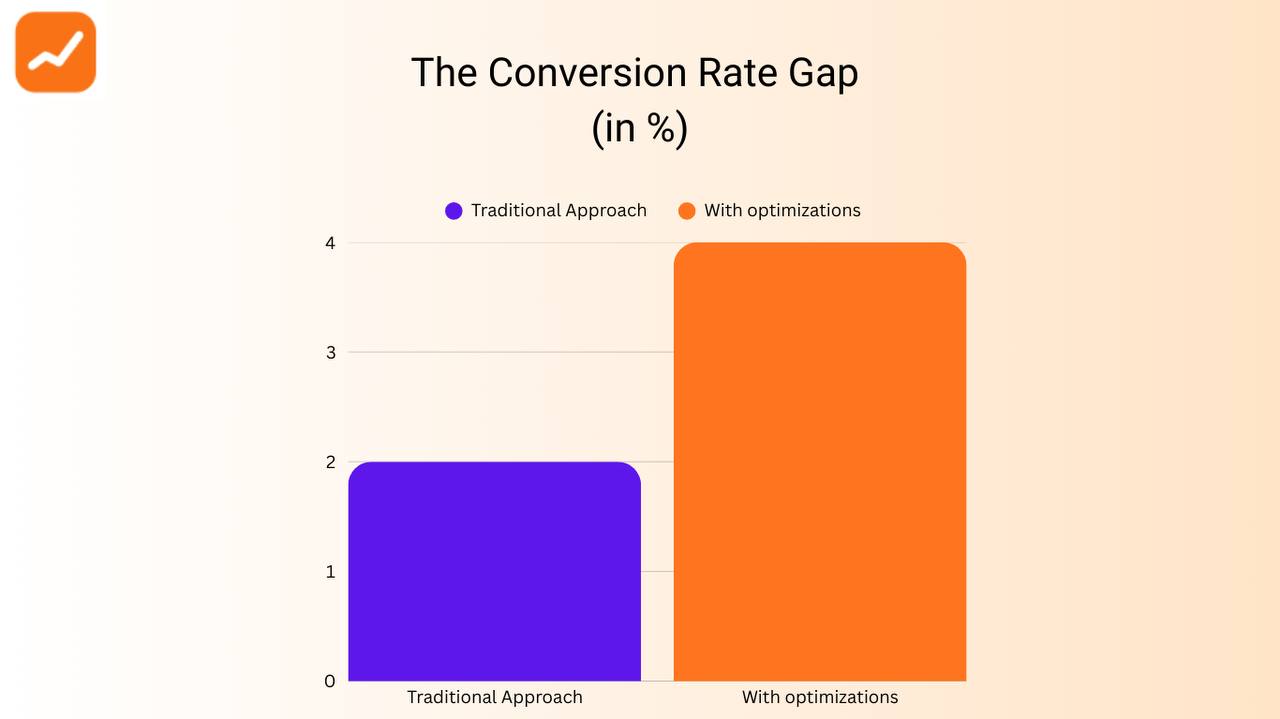
That 2% becomes 3.4-4.1%. Thus, those same 10,000 visitors will give you 340-410 customers rather than 200. That is 140-210 additional customers per month.
At $100 average customer value, that is $14,000 to $21,000 in additional monthly revenue.
The toolset needed to make this happen is priced at less than one customer. So, you break even in the first few days and profit forever after.
How to Actually Implement This (Without It Becoming a Project)
The great thing about this method is that it doesn't demand a total overhaul. You can gradually put them into effect, test the efficacy, and expand what really moves the needle.
Week 1: Set up your international pricing strategy
If you have any web traffic coming from Abroad, where to start is here. This is purely based on economics. Geographic targeting + localized pricing = instant business from the countries you were neglecting. Get it ready, ensure it's functioning, and move on.
Week 2-3: Run your first optimization test
Choose the page element that has the highest traffic for you to test. Usually, the head-line or the CTA button. Create two variations. Conduct the test for 7-14 days. Record the winner. Repeat weekly.
Week 4: Get your founder video recorded
Reserve 30 minutes. Handset camera. Shoot the video of you telling them why you made it and why they should care. 1-2 minutes is just right. Put it online. Share it live. Don't overthink it.
Week 5: Deploy the quick wins
Tab nudge (bring distracted visitors back), exit-intent offer, and social proof notifications are all features that are ready to use. Turn them on, prepare your messages, that's all.
Week 6+: Collect feedback and iterate
Put up a quick survey to find out why people leave without buying. Get 50-100 answers. Search for patterns. Solve the biggest problem. Repeat.
Once you have done this, something changes. You stop worrying about the traffic issue because you have already solved it. Now, you start thinking about the conversion issue because you can see how much money was there.
Every visitor is valuable in a different way. You are not trying to attract more visitors. You are trying to convert better. You are not wondering "should we spend more on ads?" You are asking "which objections are currently stopping people from buying?"
You start to see your traffic data in a different way. You realize that you have been throwing money at the problem whereas the solution was right in front of you.
You don't have to guess whether this works. Companies that do this right have recorded the outcomes.
Walmart transformed training into videos accessible to over a million employees. Test scores increased. Time spent off the sales floor decreased. They didn't have to change their product or their salespeople. They just made information more accessible and solved specific objections.
Unilever is present in 190 countries with very different regulations and cultures. They simplified legal and compliance content that was dense and targeted. They went from struggling to achieve 20-30% to consistently getting 90% completion. Same content. Different delivery. Better results.
Google launched peer-to-peer learning programs and made the content available in short, bite-sized formats. Within six months, participation rates reached 80%. Not because they paid people more. Because they removed the friction from accessing knowledge.
In every instance, the pattern is the same: they figured out where people were dropping off, they dealt with those specific objections, and revenue (or engagement, or productivity) increased significantly.
The Opportunity Cost of Waiting
Most founders do not bring up this topic: every day that you do not upgrade your conversion infrastructure is a day that you are not making the most of your money.
With your current metrics of 10,000 visitors per month, 2% conversion rate, and an average customer value of $100, you stand to make $20,000/month. This is good. However, if you manage to increase your conversion rate by 50% through targeted interventions, you will be able to generate $30,000/month.
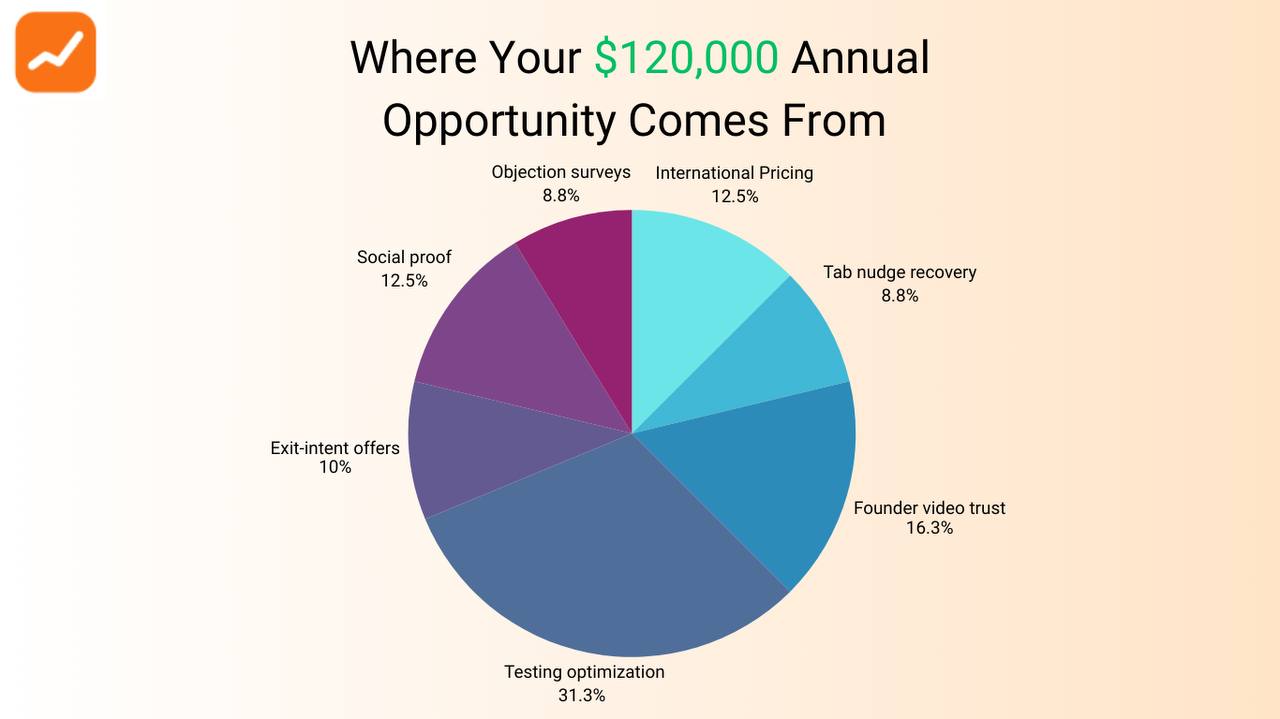
The difference between $20k and $30k per month is $120,000 per year. That money could cover a full-time salary. It could hire multiple new employees. It could extend a startup's runway. It could be the difference between a business that can sustain itself and one that has the potential to scale.
And the tools needed to capture that $120,000 in hidden revenue are priced at less than $100.
Most founders neglect that money for a considerable amount of time (months or years) while they continue to focus on traffic because that's the problem they know. The real opportunity has always been in conversion, but they don't realize it.
One More Thing: The Compounding Effect
The thing that makes this quite fascinating is that these interventions compound.
For example, you revise your international pricing strategy and consequently get 20% more customers from Brazil and India. These are new revenues that come in. Then you solve your trust issue with a founder video and thus, get another 12% from conservative buyers. Now, that's multiplicative.
You try out a new headline and achieve 8%. Then, you get a new testimonial and increase by 10%. Afterward, by optimizing your form fields you add 6%. Finally, implementing a last-minute offer helps you gain 5%
Each intervention is limited in scope. However, when combined, they have the power to completely transform your business. The great thing is that you don't put all your eggs in one basket. Instead, you are gradually stacking the small victories until all of a sudden you have become 100%+ better.
This is the way that genuine conversion optimization works. It is not about locating the one silver bullet. It is about systematically removing friction, verifying what yields results, and progressing from what you have learned.
The Conversion-First Mindset
At its core, this is about changing the way you view your business.
For probably years you have thought this way: "More traffic is what I need." To this end, you would have spent money on ads, content, and partnerships. Traffic would have gone up as well as revenue, but the latter not as fast. Something was missing.
The missing thing was that the majority of your visitors were not ready to make a purchase because you did not address their specific objections. They didn't trust you. They didn't understand your pricing in their local economy. They were being distracted by your competitors. They had questions which you never answered.
If you were to fix those issues, everything would be different. The need for new traffic would not be so pressing anymore because the traffic you currently have is exactly what you are converting. Your unit economics would get better. Your rate of sustainable growth would increase. Your business would get easier to manage.
This is not a matter of ignoring traffic. The point is that you are no longer dependent on always having to buy more.
Conclusion: The Money That Was Always There
You created something that is good enough for people to be willing to click through to your site. You have successfully done away with the problem of traffic which is the main cause of the failure of most startups. The very last thing is simply ensuring that when they come, you give them reasons to buy.
There will be some who leave because the price does not fit their economy. Therefore, you have to address it. There will be some who get distracted by competitors. Thus, you should win them back. There will be some who need to be assured of your authenticity. Hence, you should show them. There will be some who are on the fence. So, give them a last-minute reason to stay.
None of these things require changing your product. Not one of them requires you hiring new people. Not one of them requires a huge engineering effort.
What is really happening is that the money is not missing. It is simply sitting in your conversion funnel waiting to be captured.
The question is not whether you can make more money from your existing traffic. The real question is: how much are you willing to leave on the table before you decide to fix it?
Additional resources:
1. https://www.semrush.com/blog/conversion-rate-optimization/
2. https://www.invespcro.com/blog/engaging-your-visitors-increase-conversion-rate-of-website/