Conversion Rate Optimization for SaaS: The Complete 2026 Guide
Your SaaS funnel has three stages: visitor to trial, trial to PQL, and PQL to paying customer. Most founders only optimize the first stage and ignore the rest. This guide covers the exact tactics to fix leaks at every stage, from landing page copy to onboarding flows to trial expiration emails.
You're getting some traffic. Your product is solid. But only very few of your visitors actually make a purchase. The problem is not your product. The problem is your funnel.
Most SaaS founders treat conversion rate optimization as a mysterious black box. They assume it is necessary to hire costly agencies or carry out months of experiments. But the reality is quite different: conversion optimization is just a systematic method of dealing with each stage of your funnel to remove the friction.
This guide is the 2025 CRO handbook for SaaS that includes everything from basics to the exact tactics top founders implement to get more paying customers from their visitors.
What Is a SaaS Conversion (And Why It Matters)
Before we get into optimization tactics, it is worth clarifying what we actually want to optimize.
In ecommerce, a conversion is very simple: someone buys something. But in SaaS, conversions take place at various stages:
Stage 1: Visitor to Trial/Freemium - A person signs up for your free trial or freemium plan
Stage 2: Trial/Freemium to PQL - They become a product qualified lead (someone who has experienced your value)
Stage 3: PQL to Paying Customer - They switch to a paid plan
Each stage has different conversion rates and thus require different optimization tactics. Most founders only concentrate on Stage 1 and thereby, neglect the other two. It is a huge mistake.
Industry benchmarks indicate that freemium conversions average 13.7% while free trial conversions vary between 2.4% (if payment info is required) and 7.8% (if it's opt-in). But these are only averages. The top 25% of SaaS companies, by systematically optimizing each stage, convert at 2-3x these rates.
Stage 1: Getting Visitors to Try Your Product
This is the place where most founders put their efforts. And rightly so—you cannot convert people who never sign up.
Strategy #1: Craft a Landing Page That Actually Converts
Your landing page is the very first impression. It is your only opportunity to persuade someone that your product is worth their time.
The reason why the majority of landing pages fail is that they showcase features rather than benefits. They typically state something like "Advanced analytics dashboard" while they ought to say "Understand your customers' churn in no time and fix it before they leave."
The difference may sound minimal, but actually, it is everything.
A founder alone in his venture tried out this and through mere reframing of his messaging saw his conversion rate skyrocket tremendously. What he did was to replace the phrase "Production-ready Next.js boilerplate" with "Save 200 hours of development time." Shortly, it was not just the product that visitors got, but the actual value of it that they understood.
These are the things that work on landing pages with high conversion rates:
Make sure your value proposition is the first thing that a user sees without scrolling down the page. People should know what you do and why it's important without having to scroll. Your headline should be the one to communicate the benefit right away.
Use language that is oriented towards the benefits. Don't feature the product in your listing. Explain how the features benefit the customer. "One-click deployment" is a feature. "Deploy to production in 30 seconds" is a benefit.
Have several CTAs. Don't just have one call-to-action at the end. Place CTAs throughout the page so that users have the chance to convert while scrolling.
Write in a way that is understandable to everyone. Using jargon will drive people away. Even if the technical terms make perfect sense to you, they might confuse your real customers. Make everything as simple as possible.
Strategy #2: Optimize Your Free Trial Feature Set
It's a dilemma. Users will be overwhelmed and will leave if you have too many features for the trial. On the other hand, if you have too few features, they will never see the value.
The way to get there is through your data.
What functionalities do users who upgrade make use of? Which ones are completely ignored by churners? Put more effort into the features that deliver value and stop the ones that are just there for show.
Most successful SaaS companies choose to expose about 60-70% of their features to the free trial. Enough to prove real value, but still concentrated enough so that new users don't feel overwhelmed.
Strategy #3: Send Free Trial Email Sequences
It will be 3 days before your trial ends. Your user hasn't logged in since day one. This is your last opportunity.
Trial expiration emails are very important. They are not the usual "your trial is coming to an end" messages. They are targeted sequences that remind users of the value they have already experienced and create a feeling of urgency to convert.
The best trial expiration sequences look like this:
Email 1 (Day 7): Mention the first accomplishments they have made
Email 2 (Day 10): Tell them the success story of a person from their industry
Email 3 (Day 13): Limited-time offer to create urgency
Email 4 (Day 15, Trial ending): Last chance message with clear CTA
This method usually achieves the return of 10-20% of the users who would have otherwise decided to churn.
Stage 2: Converting Trial Users to Product Qualified Leads
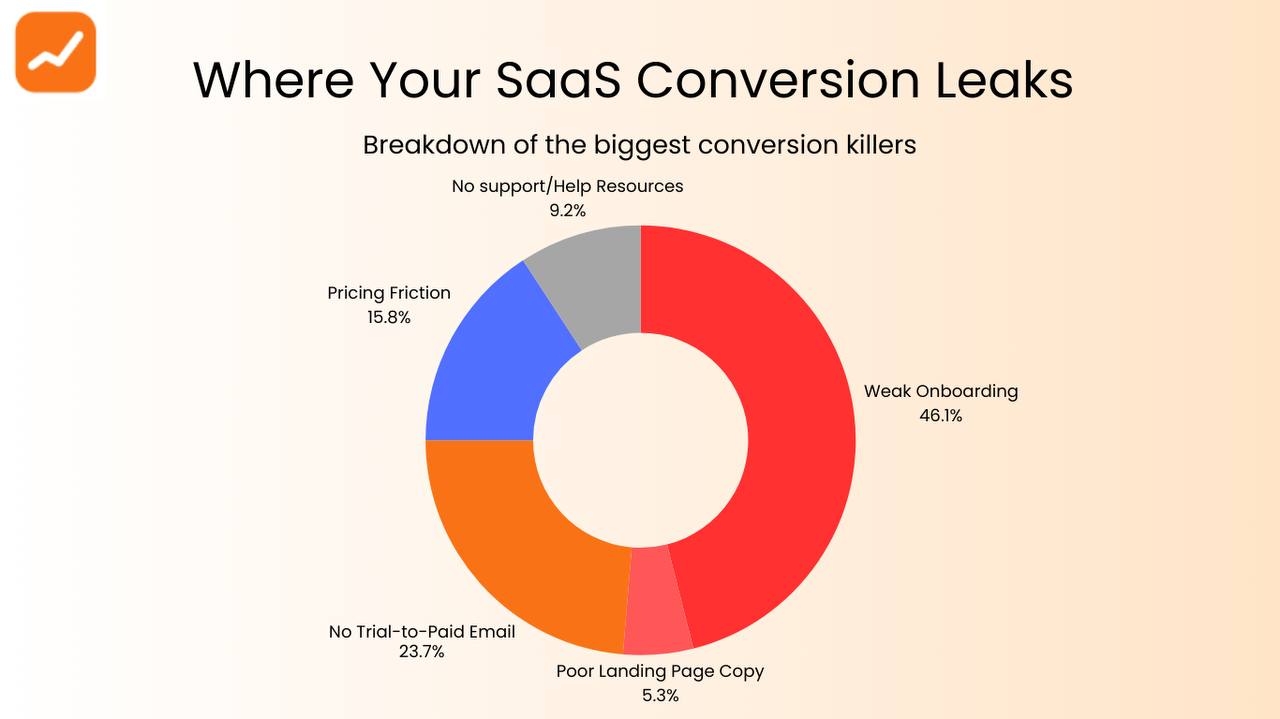
They are using your product.
Now you want them to go through the "aha moment"—that point in time when they acknowledge that your product is the one to solve their problem.
Most SaaS funnels are leaking their revenue at this point.
Strategy #1: Exceptional Onboarding
Onboarding is the place where the magic is created. A well-designed onboarding user experience is what distinguishes the user who sees the value and stays with you from the user who is lost and leaves you immediately.
Top onboarding experiences always have a certain pattern:
1. Welcome and goal setting - In the first 5 minutes, ask new users what they want to achieve
2. Guided tour - Demonstrate to them how to achieve that goal, one step at a time
3. Hands-on practice - Allow them to do it while you lead them
4. Quick win - Ensure that they come to their first success in the very first session
5. Next steps - Inform them of what to do next to get more value
Those companies which are very good at this have trial-to-PQL conversion rates of more than 40%. Those companies that skip it have conversion rates of less than 10%.
Strategy #2: Offer Multiple Support Channels
Some people may be comfortable with live chat. Others may want email. Still others may want to figure things out by using the help center.
Just provide all of them.
The inability to find the right support channel when asking for help is definitely one of those invisible things that can quietly kill your conversion rate. To solve this pain, leading SaaS companies have implemented:
Detailed help manual
Video tutorials
Interactive product tours
Chat with support for complicated questions
Email support for issues
Community forums where users support each other
By implementing this diversified strategy users can obtain help in their preferred way which lowers the friction level and makes them confident that they will be supported after they pay.
Stage 3: Converting Paying Customers
You have convinced them to try your product. Now you need them to actually pay.
Strategy #1: Build a Killer Resource Library
Not everyone learns in the same way. Some people want to be given written guides. Others may prefer video. Lastly, there are people who would want an interactive product tour.
Make different formats of learning so every user can learn in their preferred manner:
Video tutorials - For learners who are visually oriented and want to see the real application
Written guides - For people that only read and can refer to the guide later
Interactive product tours - For people that are skill-based and want to learn by doing
Webinars - For people that want to learn from experts and in the same time ask questions
FAQs - For quickly finding answers to previously asked questions
Community forums - For peer-to-peer learning
For instance, Ahrefs is a company that is incredibly effective at doing this kind of thing. They provide new users with welcome tours, tutorials, courses, and community forums, all of which are seamlessly integrated into the product dashboard. This way, users don't experience the feeling of being lost and not knowing how to use the product, which is often the cause of a drop in conversions.
Strategy #2: Incorporate High-Converting Copy Throughout Your Funnel
The copy which a solo founder optimized led to dramatic results. The main key strategies that were effective:
Feature benefits, not features. A user is not concerned with the technology of your product. He is concerned with what the technology of your product does for him.
Implement power words. Words such as "proven," "exclusive," "save," and "guaranteed," among others, kindle certain emotions in the concerned person that leads to him taking the desired action. "Instantly double your productivity" has more conversion power than "Increase your productivity."
Connect with objections directly. Instead of thinking that people do not consider pricing issues or difficulty in implementation, thus not mentioning them, you should confront them boldly in your FAQ or on your pricing page. Openness is one of the ways trust is built.
Generate urgency. "Get started now" has better conversion power than "get started whenever." Among other ways, limited-time offers, founder pricing, and early adopter pricing create that kind of urgency which ultimately leads people to overcome their hesitation.
Employ benefit-driven CTAs. Instead of using generic "Sign Up" buttons, choose action-oriented copy like "Start Shipping Faster" or "Stop Wasting Time on Tedious Tasks." These indicate the benefit that the users will get directly.
The Data Behind High-Converting SaaS Funnels
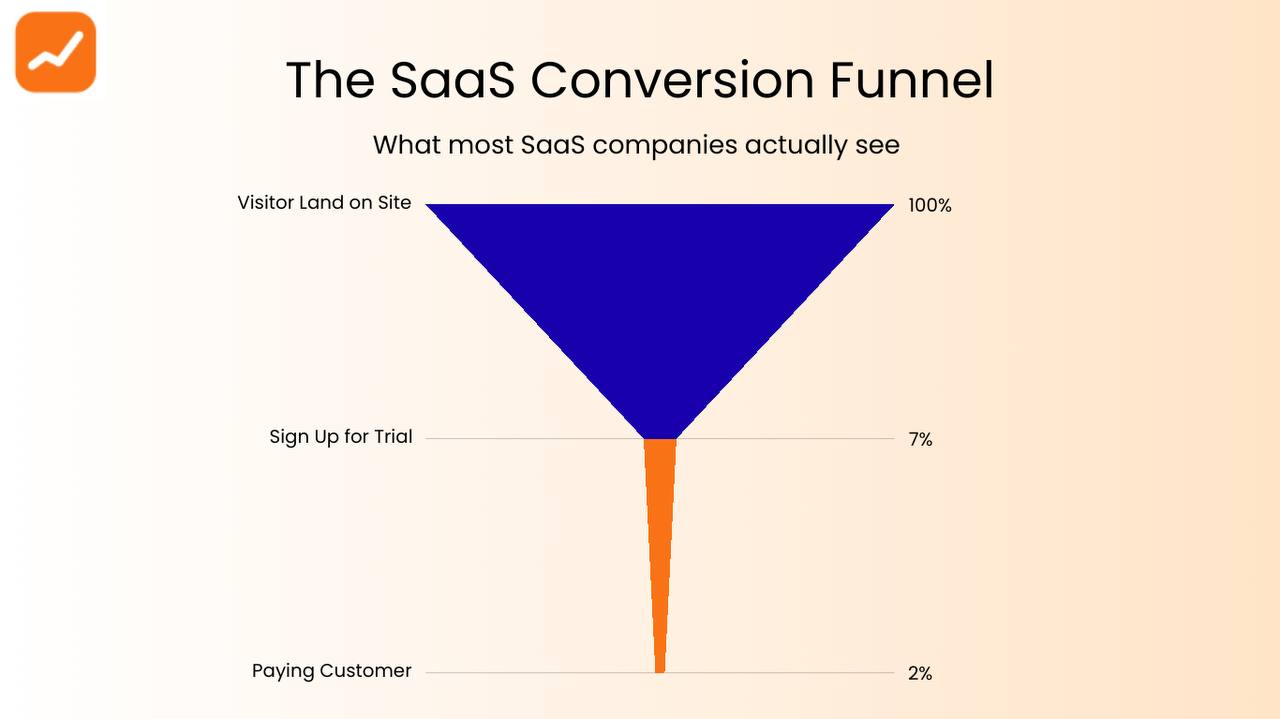
Here is the data that reflects SaaS conversion rates in 2025:
Single SaaS conversion (visitor to trial): A minimum of 7%. The top 25% of the performers can achieve conversion rates from 15% to 25%
Average trial-to-pay conversion rate: 1/5 or 20%. Top 25% have trial-to-paid conversion rates higher than 40%
The average multi-stage funnel from visitor to paying customer: About 1-2%. While the top 25% go as far as 3-5%
The gap between average performers and top performers is not due to chances. It is due to the systematic optimization of every stage. Incrementing by 1% Stage 1, 2% Stage 2 and 1.5% Stage 3 will result in the total conversions being three times higher.
The Common Mistakes That Kill Your Conversion Rate
Mistake #1: Optimizing the wrong stage. Founders usually focus on getting more trials when their trial-to-paid conversion is very low. Locate and fix the bottleneck, not the top of the funnel.
Mistake #2: Ignoring the data. It's impossible to optimize without measuring. Conversion tracking should be done at each stage. Be aware of your figures.
Mistake #4: Simultaneously changing too many things. In case you change your headline, copy, CTA, and offer all at the same time, you won't be able to find out what very idea worked. Simply change one variable, measure, and then proceed to the next one.
Mistake #5: Not testing at all. The founders who are 'crushing it' are always running continuous experiments. They are constantly testing new copy, new offers, new onboarding flows. If you are not testing, then you are going backward.
Your Action Plan
Do this this week:
Perform a funnel audit. Determine your conversion rate for each stage of the funnel. At which stage is the most significant leakage occurring? Begin there.
Experiment with your landing page. Conduct an A/B test of your headline. Do not change anything else. Allow it to run for two weeks. Evaluate the winner.
Make your onboarding better. Observe how the new user goes through your onboarding process. Where do they encounter friction? Fix the biggest pain point.
Check out your trial-to-paid email sequence. Is it telling a story? Is it creating urgency? If not, then add one win-focused email.
Experiment with your CTA copy. Change your button from "Start Free Trial" to something benefit-driven like "See Your Results in 5 Minutes." Evaluate.
Begin with one. Don't attempt to repair everything simultaneously. Small, systematic improvements eventually lead to massive gains.
The Bottom Line
Conversion rate optimization for SaaS doesn't need to be a big brain work. It simply involves a series of logical steps. Firstly, you figure out your biggest loss. Then you come up with a hypothesis on what could possibly fix it. Next, you test it. After that, you measure. You implement the winner. After that, you repeat.
The founders who will be successful in 2026 are not more intelligent than you. They are just more systematic. They are using their funnel as a product—constantly improving, always testing, always learning from data instead of making guesses.
Why not start today? Choose one stage. Conduct one test. Obtain your result. Proceed.
The optimal time to increase your SaaS conversion rate was 12 months ago. The second best time is now.
Links you may find useful:
1. https://getrevdock.com/blog/how-to-make-more-money-from-the-same-website-traffic
2. https://getrevdock.com/blog/why-your-visitors-leave-without-buying
3. https://getrevdock.com/blog/how-to-make-more-money-from-the-same-website-traffic